
New Review Highlights Why Airborne Nanoparticles Matter in Pregnancy
A new open-access review article has put a spotlight on a topic that sits at the heart of the UPRISE project: how tiny airborne particles interact with the body, and why that matters during pregnancy.
Published in CHIMIA as part of the special issue “Nanoparticle Research in Switzerland – From the Past to the Future,” the article explores how airborne particulate matter and engineered nanoparticles enter the body, cross biological barriers, and may affect human health, with a special focus on pregnancy. The special issue also highlights Switzerland’s leading role in nanoparticle research, including filter technologies and international scientific collaboration.
Why this matters for UPRISE
This publication is an important step forward for the broader field that UPRISE contributes to. In the review, the authors point to UPRISE as one of the new multidisciplinary research efforts helping to address key knowledge gaps. They describe UPRISE as bringing together environmental scientists, clinicians, and public health experts to study how PM0.1 and micro- and nanoplastics (MNPs) influence fetal health. The paper also notes that UPRISE combines epidemiological data with advanced human placental models to help establish causal links between maternal exposure and adverse birth outcomes, with the goal of informing interventions and health policy.

©Empa, Swiss Federal Laboratories for Materials Science and Technology
Key takeaways from the review
One of the clearest messages from the paper is that inhalation is a major route of exposure. The authors explain that people are exposed to tiny airborne particles in daily life, and that the smallest fraction can cross the air-blood barrier and reach the bloodstream. They also note that micro- and nanoplastics are part of this airborne particle picture, including particles formed through degradation and abrasion such as vehicle tire wear.
The review also reinforces why pregnancy is a sensitive window of exposure. It describes growing evidence that some inhaled particles can enter systemic circulation and that, to reach the developing fetus, they must cross the placenta. The paper notes links between particulate matter exposure and adverse pregnancy outcomes such as preterm birth and preeclampsia, and it highlights that black carbon and microplastics have been detected in placental tissue.
Another important takeaway is that harm may occur through different biological mechanisms. The authors discuss direct and indirect toxicity, as well as the so-called “Trojan Horse effect,” where particles can enhance toxicity by carrying harmful substances into the body. At the same time, they stress that major knowledge gaps remain, especially around which particle properties drive toxicity, and around the need for more sensitive exposure assessment and detection methods, particularly for nanoplastics.
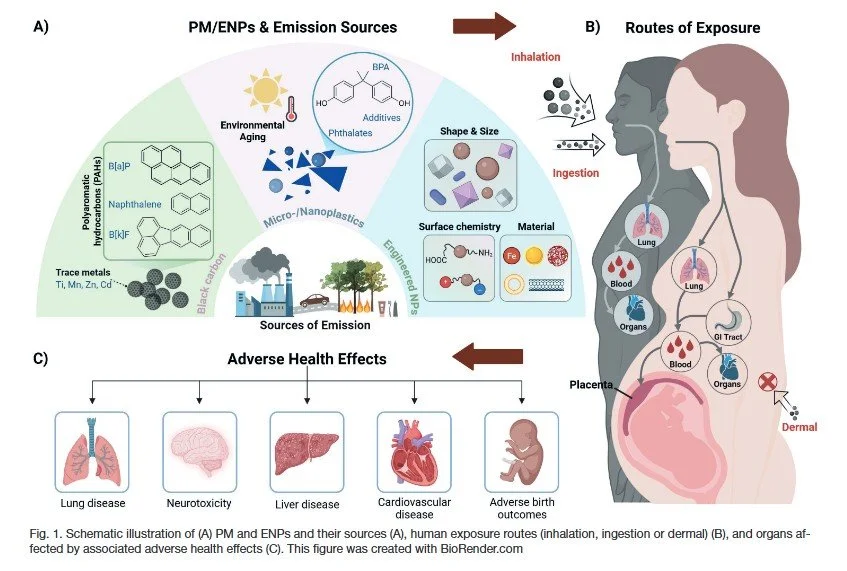
Copyright (c) 2026 Ceryl J. Y. Koh, Sina Ruhstaller, Emma Westenberg, Loretta Müller, Tina Buerki-Thurnherr
Looking ahead
For UPRISE, this review is a welcome sign that the scientific community is increasingly focusing on the kinds of invisible exposures that may affect health from the very beginning of life. It also underlines why cross-disciplinary research is so important: better evidence on exposure, placental biology, and early-life effects can help strengthen risk assessment, support smarter policies, and improve protection for future generations.
Read the article: Airborne Nanoparticles and Human Health: Toxicological Insights with a Focus on Inhalation Exposure and Mechanisms of Toxicity During Pregnancy | CHIMIA