
Inside UPRISE: Studying Invisible Pollutants with Nanotechnology
The International Iberian Nanotechnology Laboratory (INL) is one of the key partners in the UPRISE project, bringing cutting-edge expertise in nanotechnology to help better understand how environmental pollutants may affect human health.
Established in 2005 by the Governments of Portugal and Spain, INL is an international research organisation dedicated to advancing innovation in nanoscience and nanotechnology across a wide range of applications. Within UPRISE, INL contributes its specialised knowledge and advanced analytical techniques to investigate how extremely small particles interact with the human body.
Why this research matters
Air pollution is not only made up of gases — it also includes tiny particles that are invisible to the human eye, such as ultrafine particles and micro- and nanoplastics. These particles are increasingly present in the environment, yet their effects on human health, particularly during pregnancy, are still not fully understood.
As INL researchers explain:
“Tiny plastic particles are now part of the air we breathe, yet we still know very little about how they may affect pregnancy and early life. In UPRISE, we are investigating whether micro- and nanoplastics can reach the placenta. This is essential to protect the most vulnerable among us - mothers and babies.”
This research is especially important because pregnancy represents a sensitive window of exposure, where environmental factors can influence both immediate and long-term health outcomes.
Tackling complex scientific challenges
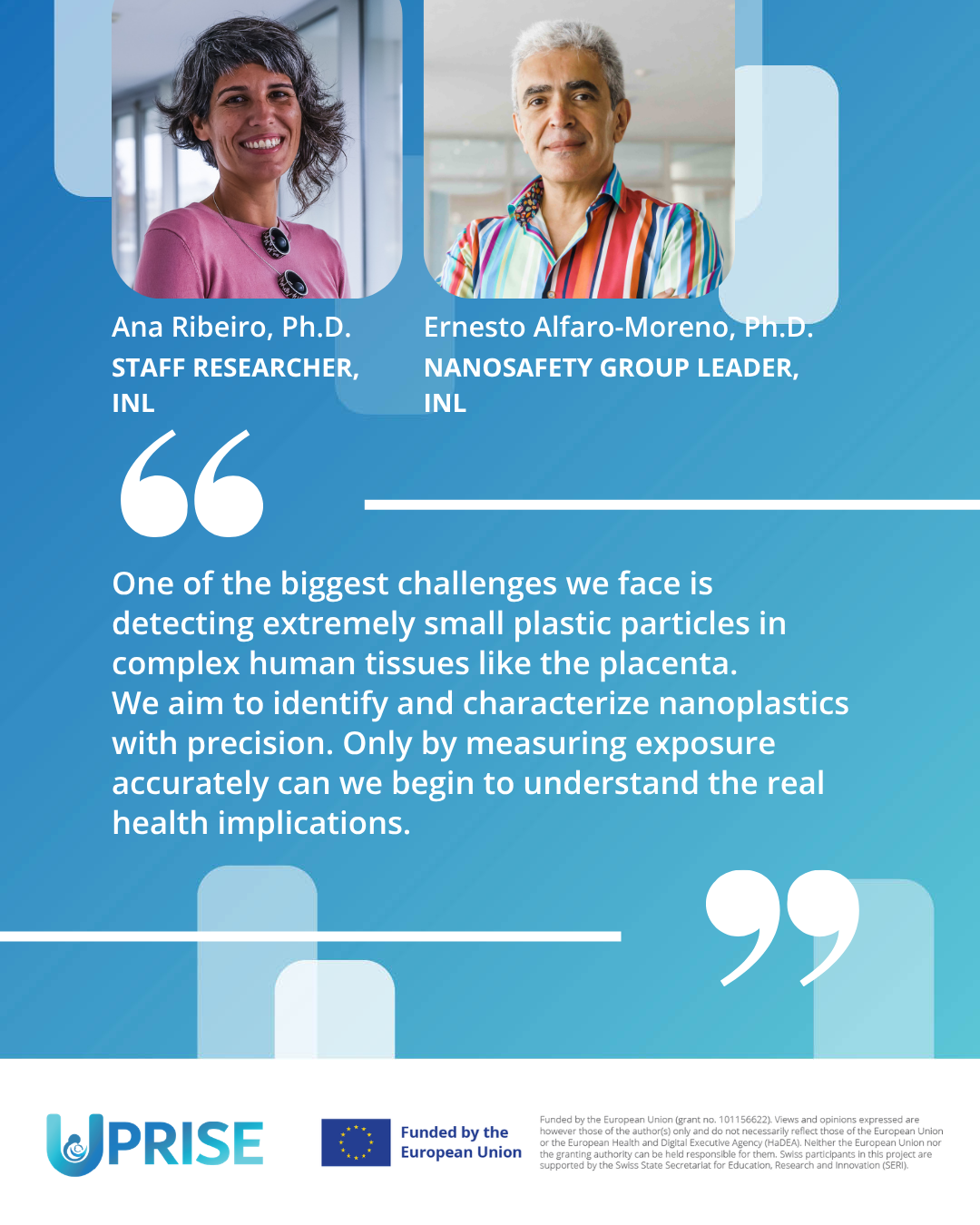
One of INL’s main contributions to UPRISE is addressing a critical technical challenge: detecting and analysing extremely small plastic particles in human tissues.
Because nanoplastics are so tiny and often embedded in complex biological samples, identifying them requires highly specialised tools and expertise.
By applying advanced techniques such as Raman spectroscopy*, INL helps generate reliable data on exposure — a crucial step toward understanding how these particles may affect health.
* Raman spectroscopy is a scientific method used to find out what something is made of — even if it’s extremely small. Imagine shining a light (usually a laser) onto a tiny particle. When the light hits it, the way the light “bounces back” changes depending on the material.
Why this matters for all of us
Although these particles are invisible, their potential impact is very real. Understanding how they behave in the body is essential not only for scientists and policymakers, but for society as a whole.
Air pollution doesn’t only consist of gases - it also includes ultrafine particles and micro- and nanoplastics that are invisible to the naked eye. These particles may travel through the body in ways we are just beginning to understand. Research like UPRISE helps clarify what this means for pregnant women and the next generation. By contributing to UPRISE, INL is helping to close important knowledge gaps and provide the scientific evidence needed to better protect public health — especially for the most vulnerable.
Working together for healthier futures
INL’s work is part of a broader multidisciplinary effort within UPRISE, bringing together experts from environmental science, medicine, and public health. Together, the consortium aims to uncover how environmental exposures shape health from the earliest stages of life and to support policies that create safer, healthier environments.
Through collaboration and innovation, partners like INL are helping to make invisible risks visible — and to build a healthier future for the next generation.