How can we better understand pollutants we cannot see, and turn that knowledge into action to protect our health?
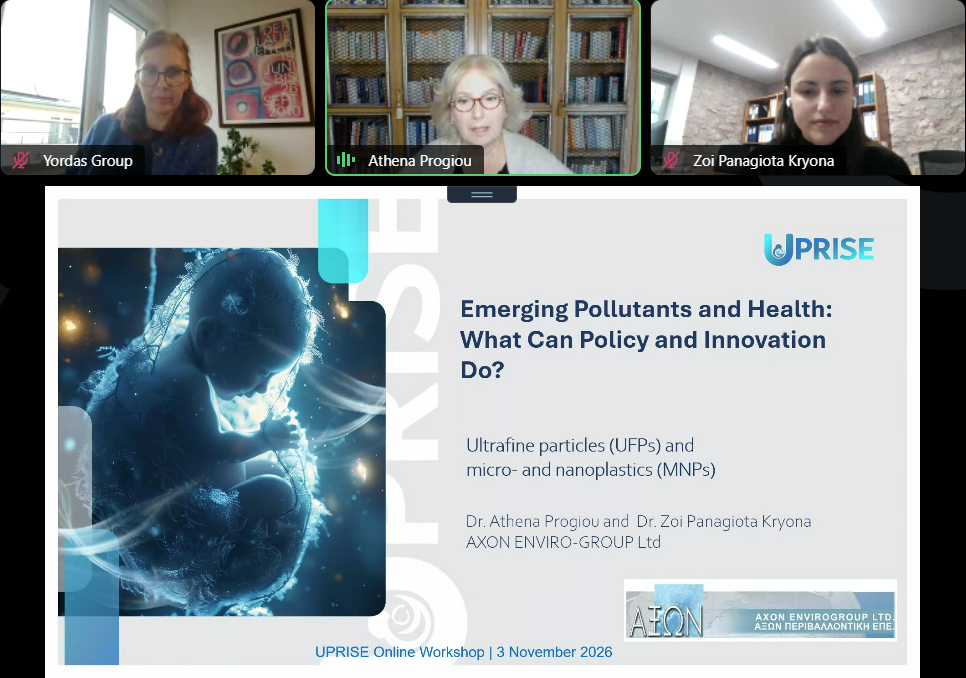
On November 3, 2026, UPRISE held its first online workshop, “Emerging Pollutants and Health: What Can Policy and Innovation Do?” Organized by project partners Yordas Group and AXON ENVIRO-GROUP Ltd., the session featured Athena Progiou and Zoi Panagiota Kryona from AXON. The workshop explored research on ultrafine particles and micro- and nanoplastics, the challenges of measuring exposure, and the implications for policymakers and innovators.
Understanding the tiny pollutants around us
The presentation began by explaining the particles at the heart of UPRISE’s research. Ultrafine particles (UFPs) are extremely small airborne particles, approximately 100 nanometers or less in diameter. Micro- and nanoplastics (MNPs) are small pieces of plastic, with UPRISE focusing on particularly small airborne fractions.
The speakers explored sources ranging from traffic, heating, and industrial activities to the wear and breakdown of plastic-containing materials. These examples connected the science to familiar environments: the roads we travel on, the homes we live in, and the air around us.
What does the research tell us about health implications?
The workshop highlighted recent studies examining the potential health burden of UFP exposure. These included an estimate of approximately 419,000 new cardiovascular disease cases annually in the EU and a separate estimate of 1.99 million premature deaths worldwide each year attributable to UFP exposure. Both are research-based estimates with substantial uncertainty, rather than directly counted cases, underlining the importance of further exposure monitoring and health studies.
The presentation also explored findings from the AURORA research project that are particularly relevant to pregnancy research. In laboratory models of the human placental barrier, researchers found that some tested plastic particles could cross the model barrier and alter hormone levels. These findings help identify possible biological mechanisms, but do not, on their own, establish health effects in pregnant women or babies under everyday exposure conditions.
The distinction matters: understanding where particles are found is one step; establishing what they mean for health requires additional evidence.
Better measurements, better understanding
A central message was that measuring pollution in an area is not the same as understanding a person’s exposure.
The speakers highlighted several challenges. Different instruments may detect different particle sizes, making results difficult to compare. Pollution maps may miss brief peaks near particular sources. Indoor environments and daily travel also influence exposure, meaning outdoor measurements alone cannot tell the whole story.
For UFPs, counting particles is especially important because their tiny size means they contribute relatively little mass. WHO guidance therefore recommends particle-number measurements and expanded monitoring to strengthen exposure assessment.
Connecting evidence with prevention
These challenges are closely connected to UPRISE’s mission of making invisible risks visible.
The project combines environmental monitoring and exposure modeling with clinical research and biological studies to investigate how airborne UFPs and MNPs may affect pregnancy, babies’ development before birth, and adverse birth outcomes such as preterm birth. Its goal is to build evidence that can support public health recommendations and inform environmental policy.
The workshop brought this connection between research and action into focus: better measurements, more representative exposure data, and a clearer understanding of biological effects can strengthen the basis for decisions about pollution and health.
Thank you to our speakers, organizing partners, and everyone who joined the session. Sharing knowledge across research, policy, and innovation is an important part of moving this work forward.
Watch the presentation recording
Missed the live workshop, or would you like to revisit the presentation?
Watch the recording below to learn more about emerging pollutants, the research presented, and the challenges and opportunities for policy and innovation.