
Making Invisible Risks Visible: Connecting Environmental Exposure and Health
Air pollution is often imagined as something visible: smoke rising from a factory, traffic haze over a city, or smog clouding the skyline. But some of the most important environmental risks for human health cannot be seen or smelled.
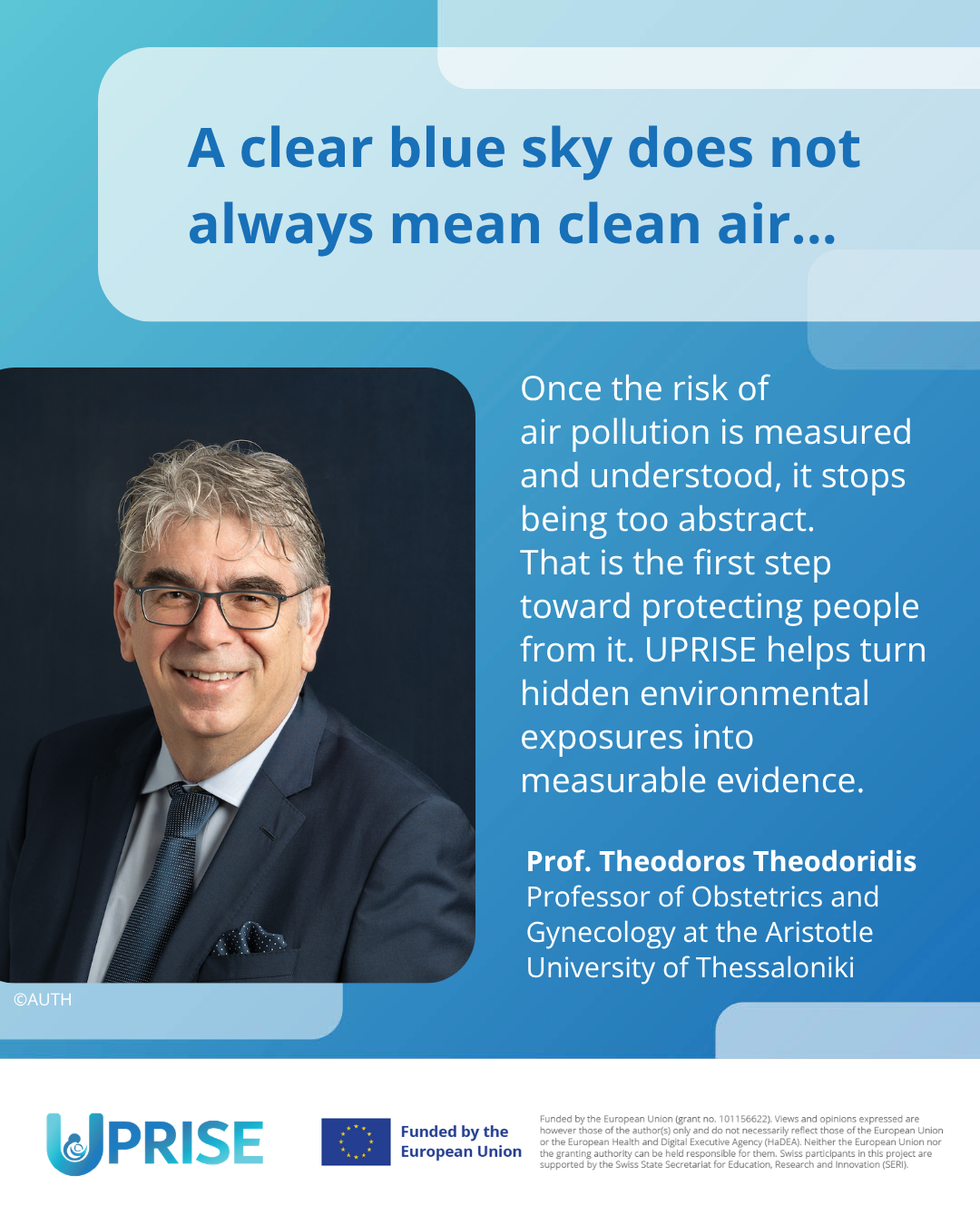
For Prof. Theodoros Theodoridis, Professor of Obstetrics and Gynecology at the Aristotle University of Thessaloniki, this is one of the central challenges UPRISE aims to address.
“A clear blue sky does not mean clean air,” he explains. “The particles and chemicals that matter most for health are usually invisible and odorless.”
Within UPRISE, his team contributes a vital clinical perspective to the project’s wider mission of making invisible risks visible. Their work focuses on investigating the links between everyday environmental exposures and human health by recruiting participants, collecting health information and biological samples, and connecting these data with measurements of the air and surroundings people are exposed to in their daily lives.
Turning hidden exposures into measurable evidence
Many people still associate air pollution mainly with the lungs. While respiratory health is an important part of the picture, environmental exposures can affect the body in much broader ways.
Tiny particles and chemicals can enter the bloodstream and influence different systems throughout the body. For pregnancy and early-life health, understanding these pathways is especially important, as exposures during sensitive stages of development may have long-term consequences.
For the clinical team in Thessaloniki, “making invisible risks visible” means transforming exposures that people cannot see, feel, or easily measure into clear scientific evidence. Most people have no way of knowing what they are exposed to during an ordinary day. By combining environmental monitoring with health data, UPRISE can begin to show how these hidden exposures may relate to health outcomes.
Once a risk is measured and better understood, it becomes less abstract. It can be studied, communicated, and eventually addressed through better prevention, public health advice, and policy.
Adding the clinical piece to a larger puzzle
One of the major challenges in environmental health research is that the effects of everyday exposures can be subtle, gradual, and difficult to detect. Unlike a single acute exposure, the health impacts of air pollution may accumulate over time and interact with many other factors.
The Aristotle University of Thessaloniki team helps address this challenge by carefully following participants and linking clinical information with real-world exposure data. Their work provides an essential clinical piece of the UPRISE puzzle.
This is especially important because no single discipline can fully answer the questions UPRISE is asking. Understanding how ultrafine particles and micro- and nanoplastics may affect pregnancy, fetal development, and early-life health requires expertise from medicine, environmental science, engineering, toxicology, data science, and public health.
Research for prevention and future generations
For UPRISE, generating scientific knowledge is not an end in itself. The goal is to build evidence that can help protect people, especially those who may be most vulnerable to environmental risks.
If researchers can identify which exposures are harmful, when they matter most, and under which conditions they become a risk, this knowledge can support better public health recommendations, smarter environmental and urban policies, and earlier prevention.
This preventive perspective is key. Research can help protect future generations not only by improving how illness is treated once it appears, but by helping to reduce harmful exposures before health problems begin.
Collaboration beyond borders
Environmental health challenges do not stop at national borders. Air pollution, climate-related pressures, and emerging contaminants affect people across regions and populations. This is why international and interdisciplinary collaboration is central to UPRISE.
By bringing together doctors, environmental scientists, engineers, data specialists, public health experts, and many others, UPRISE can study invisible environmental risks from multiple angles. Data from different countries and populations also help researchers understand whether findings are relevant beyond one specific setting.
For the Aristotle University of Thessaloniki team, this collaboration strengthens the science and makes the results more meaningful for people everywhere.
Through this shared effort, UPRISE is working to make hidden environmental exposures visible, measurable, and actionable, helping to build the evidence needed for healthier pregnancies, healthier babies, and healthier future generations.